QbTest vs. QbCheck: In-Clinic vs. Remote
QbTest and QbCheck are both made by Qbtech, and both measure attention, impulsivity, and motor activity during a computerized continuous performance test (CPT). The main difference is where and how they run. QbTest is in-clinic only and uses dedicated hardware: a headband marker, an infrared motion camera, and a responder button [1][2]. QbCheck runs on the patient’s own laptop, using the spacebar and the laptop’s webcam, and can be taken at home [2][3]. According to the FDA summary, QbCheck was cleared as substantially equivalent to QbTest [2].
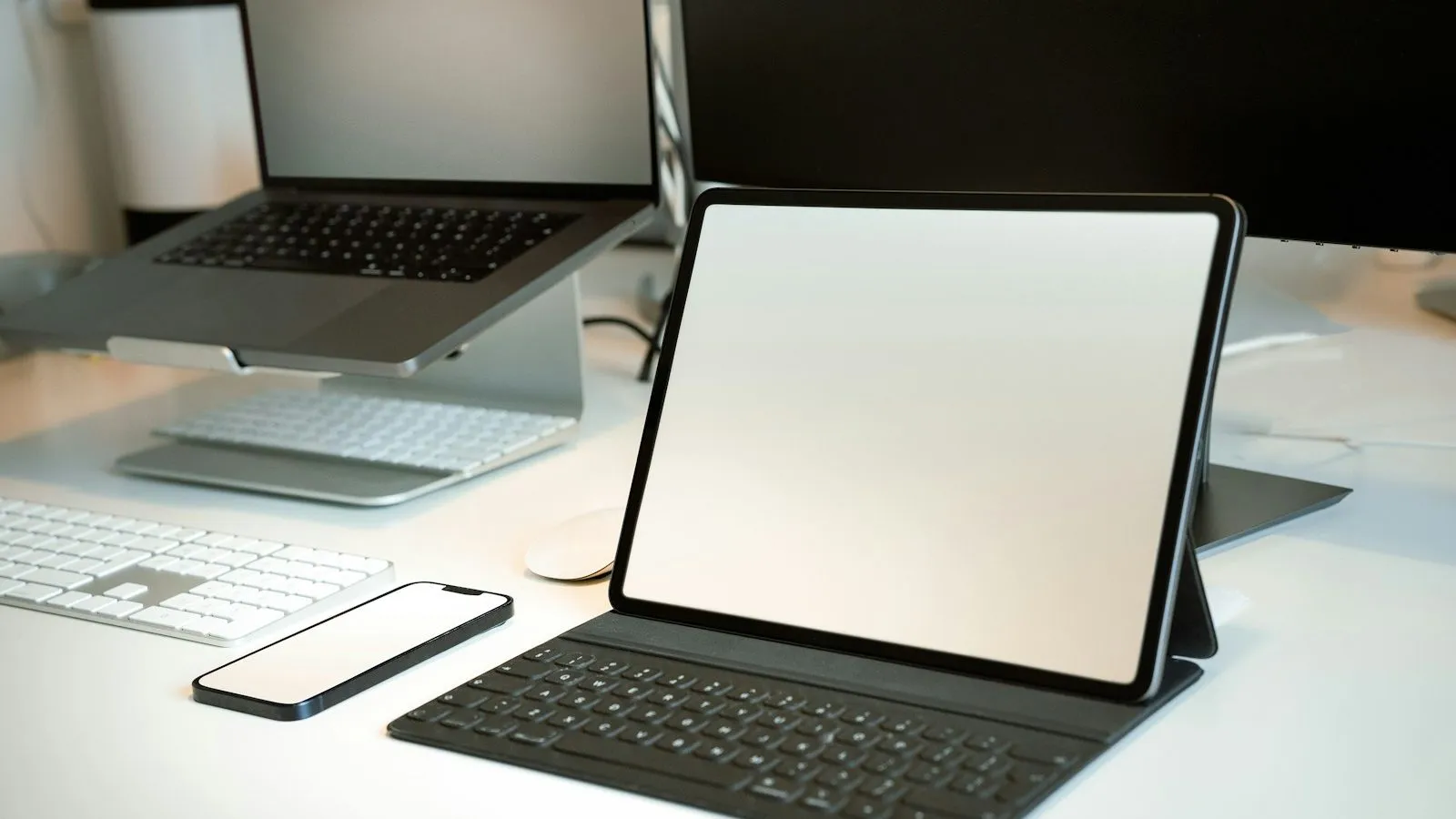 Photo by Jakub Żerdzicki on Unsplash
Facts are from Qbtech’s website and the FDA 510(k) database, accessed September 27, 2026. AxonCPT is not affiliated with Qbtech. QbTest, QbCheck, and QbPath are trademarks of their owner and are used here for identification only.
QbTest vs QbCheck at a glance
| QbTest | QbCheck | |
|---|---|---|
| Setting | “Restricted to in-clinic only” [1] | Remote through the QbPath patient portal, or in-clinic [3] |
| Hardware | Headband with reflective marker, infrared motion-tracking camera, stand, responder button [1][2] | Patient’s Mac or Windows laptop with built-in webcam; spacebar responses [2][4] |
| Motion tracking | Infrared camera tracks a reflective marker [2] | Laptop webcam; Qbtech says “No images are captured during the test” [4] |
| What it measures | Hyperactivity, impulsivity, inattention [1] | Hyperactivity, impulsivity, inattention [4] |
| Test length | 20 minutes [1] | 15 or 20 minutes depending on age, plus setup time [4] |
| Ages | 6–60 [1] | 6–60 [3] |
| FDA 510(k) | K040894 (2004), K122149 (2012), K133382 (2014); product code LQD [5] | K143468 (March 22, 2016); product code LQD [5] |
| Published price (list price on qbtech.com, accessed Sept 27, 2026) | Not publicly listed [1] | “Starting from £65 / $68 / €75 per test”; credits valid 12 months [3] |
How are QbTest and QbCheck different?
Hardware and setting
QbTest is a clinic installation. Qbtech lists its equipment as a “headband, motion-tracking camera, and stand,” and it runs only in the clinic [1]. The FDA 510(k) summary for QbCheck describes the changes from QbTest: “Instead of a responder button, the test-taker uses the spacebar to respond to targets and instead of an infrared camera and a reflective motion marker, the test-takers motor activity during the test is registered by the web camera” [2].
The same summary says QbCheck “provides the same functions and the test has an identical design,” and that “no extra hardware is needed as the test is performed on the user’s own computer” [2].
Device requirements for QbCheck
Qbtech’s QbCheck FAQ (posted April 2023) lists these requirements:
- A laptop or Mac with a built-in webcam and an Intel Core i5 processor or higher
- A USB Type-A port or adapter
- An internet connection
- Google Chrome, or recent versions of Edge (Windows 10) or Firefox
The FAQ adds that “Smartphones, Chromebooks, Surface and Tablets are not compatible” [4]. Qbtech’s current product page describes the requirement as Mac or Windows laptops [3]. Confirm current requirements with Qbtech.
The FAQ also sets room requirements. Examples include blinds to block bright sunlight, a stool without back support for ages 6–11, and a chair without arms or unlockable wheels for ages 12–60. It advises that “a test administrator observes the individual during the test, where possible,” without interacting [4].
Intended use and evidence
QbCheck’s cleared intended use is to provide “objective measurements of hyperactivity, impulsivity, and inattention to aid in the clinical assessment of ADHD and in the evaluation of treatment interventions in patients with ADHD,” with results “interpreted only by qualified healthcare professionals” [2].
On evidence, Qbtech states that “QbTest and QbCheck are considered equivalent in their clinical utility, intended use, and ability to measure the core symptoms of ADHD” [6]. Its FAQ says QbCheck “benefit[s] from the same documentation as QbTest” [4]. The best-known trial used QbTest. In the 2018 AQUA randomized trial of 267 children and young people referred for ADHD assessment in England, clinicians who received the QbTest report were more likely to reach a diagnostic decision. At 6 months, 76% had a decision, compared with 50% without the report. Appointment length fell by 15%, and there was “no difference in diagnostic accuracy” [7]. Those results come from in-clinic QbTest in a pediatric NHS setting.
Neither product is a standalone diagnostic test. A 2024 systematic review of CPTs in adults concluded that CPTs “should not be used in isolation as a diagnostic test but may be beneficial when used as a component of a comprehensive assessment” [8]. (That review covered other commercial CPTs, not the Qbtech products.)
Pricing
Qbtech publishes a QbCheck price on its Growth plan: “Starting from £65 / $68 / €75 per test.” Purchases are invoiced upfront, and credits are valid for 12 months with automatic renewal when they are used. Enterprise pricing is custom [3]. QbTest pricing is not published on Qbtech’s product page [1]. For more detail, see our breakdown of QbCheck pricing for clinicians.
When to choose QbTest vs QbCheck
QbTest may fit when:
- You assess patients in person and want a controlled clinic environment with dedicated hardware [1]
- You want the product used in the AQUA trial [7]
- Your patients may not have a compatible laptop
QbCheck may fit when:
- You assess by telehealth and want Qbtech’s motion measurement at home [3]
- Your patients have a compatible Mac or Windows laptop with a webcam [4]
- You want to avoid buying clinic hardware, and a published per-test price works for your volume [3]
Either way, remote results depend on testing conditions. Our guide to remote vs. in-office ADHD testing covers the tradeoffs, and remote CPT testing validity covers environment controls.
Frequently asked questions
Is QbCheck the same test as QbTest? Qbtech and the FDA summary describe the same test design with different hardware. QbCheck uses the spacebar and a webcam, while QbTest uses a responder button and an infrared camera with a reflective marker [2]. Qbtech considers them equivalent in clinical utility [6].
Are both QbTest and QbCheck FDA-cleared? Yes. The FDA 510(k) database lists QbTest (K040894, K122149, K133382) and QbCheck (K143468) under product code LQD [5].
Can QbCheck be done at home? Yes. Clinicians send a unique URL, and the patient completes the test through the QbPath portal on a compatible laptop [3][4].
Is QbTest or QbCheck covered by insurance? Coverage depends on the payer. Some policies treat continuous performance tests as unproven for ADHD. See is ADHD CPT testing covered by insurance?
Other remote options, and how this looks in practice
If your patients don’t have a webcam laptop, or you don’t need a motion measure, other remote CPTs run on different devices. AxonCPT is one. You send a link, and the patient completes the test in about 16 minutes in a browser on a phone, tablet, or computer, with no app or login. You get a report immediately, with five metrics compared against age- and sex-matched norms. AxonCPT does not measure motor activity. You can see what the report looks like or read about objective ADHD testing with AxonCPT.
Try it with your next patient. AxonCPT gives you 2 free tests every month — no card required. Send a link, your patient finishes in ~16 minutes from home, and you get a norm-referenced report instantly. Create your free account →
In practice, whichever tool you use: confirm the patient’s device at intake, send pre-test instructions, review the report with rating scales and the interview, and retest with the same instrument at dose changes. For how QbTest and QbCheck compare against T.O.V.A., Conners CPT 3, and IVA-2, see our full CPT comparison.
Start testing your patients with AxonCPT
If device limits keep some patients from remote testing, AxonCPT gives you a browser-based option to use alongside your other tools. It includes 2 free tests every month, with no card required. Create your free AxonCPT account or learn more at axoncpt.com.
References
- Qbtech. QbTest. Accessed September 27, 2026.
- U.S. Food and Drug Administration. 510(k) Summary, K143468 (QbCheck). Predicate device: QbTest (K133382).
- Qbtech. QbCheck. Accessed September 27, 2026.
- Qbtech. QbCheck Frequently Asked Questions (PDF). Document posted April 2023; accessed September 27, 2026.
- U.S. Food and Drug Administration. 510(k) database records for product code LQD via openFDA; see also K143468. Queried September 27, 2026.
- Qbtech. Clinical Documentation for QbTest and QbCheck. Accessed September 27, 2026.
- Hollis C, Hall CL, Guo B, et al. The impact of a computerised test of attention and activity (QbTest) on diagnostic decision-making in children and young people with suspected ADHD: single-blind randomised controlled trial. J Child Psychol Psychiatry. 2018;59(12):1298–1308.
- Varela JL, et al. A systematic review of the utility of continuous performance tests among adults with ADHD. Clin Neuropsychol. 2024;38(7):1524–1585.